
Graphics card shop, Jongno-gu
About Lumivane, a GPU shop in Jongno-gu
Lumivane is a graphics card shop at 12, Saeun-ro, Jongno-gu, Seoul, 03157. We sell current NVIDIA RTX 50-series and AMD Radeon cards, and we spend most of our time explaining them to people who are about to spend a significant amount of money on one part.
What we actually do
We stock graphics cards, check compatibility against your build, and give straight advice on whether the card you came in for is right for your monitor, case, and power supply. That last part is most of the job.
People arrive with a model number in mind and leave with a different one fairly often, because the model they wanted does not fit their situation. A 5070 that would serve a 1440p high-refresh monitor is real money wasted if the case has 280mm of clearance and the power supply is a 550W unit from an older build. We would rather spend fifteen minutes on your setup than have you come back with a card that never leaves its box.
Bring these four things
- You have in hand Case model, PSU wattage
- You know from memory Monitor resolution, refresh
- You should decide first Budget ceiling, roughly
Why we focus on the current generation
RTX 50-series cards and the AMD RX 9070 XT are what Korean buyers are asking about in 2026. The 5070, the 5060 Ti in both memory versions, and the base 5060 make up most of the conversation. We keep current models in stock and write about them in plain language, because the spec sheets are not written for people buying their first card.
That focus is deliberate. Older generations still work, but a shop that stocks everything tends to explain nothing well. We would rather know the current lineup properly — which memory size performs how, which cooler is quiet, which card needs a bigger power supply than most people assume — and answer from that.
In the conversation now
- Most asked about RTX 5070
- Two memory versions RTX 5060 Ti
- Entry pick RTX 5060
- AMD side RX 9070 XT
How we explain a card
We start with what you play and what monitor you own. Then VRAM, then cooler design, then price. The order matters, because starting with price leads people to the wrong card for their build.
-
First
Games and monitor
If you tell us you play at 1440p and want ray tracing on, that narrows the list faster than any benchmark chart. A 1080p 60Hz screen and a 1440p 165Hz screen want different cards, and nobody should pay for frames their monitor cannot show.
-
Second
VRAM
Memory size decides how a card ages. This is where the two RTX 5060 Ti versions differ, and it is the first thing we ask about when your build is meant to last several years.
-
Third, then price
Cooler, then the figure
A quiet cooler and enough clearance matter more than factory overclock numbers. Price comes last, once there is a card worth pricing.
Compact builds we check first
Small form factor cards
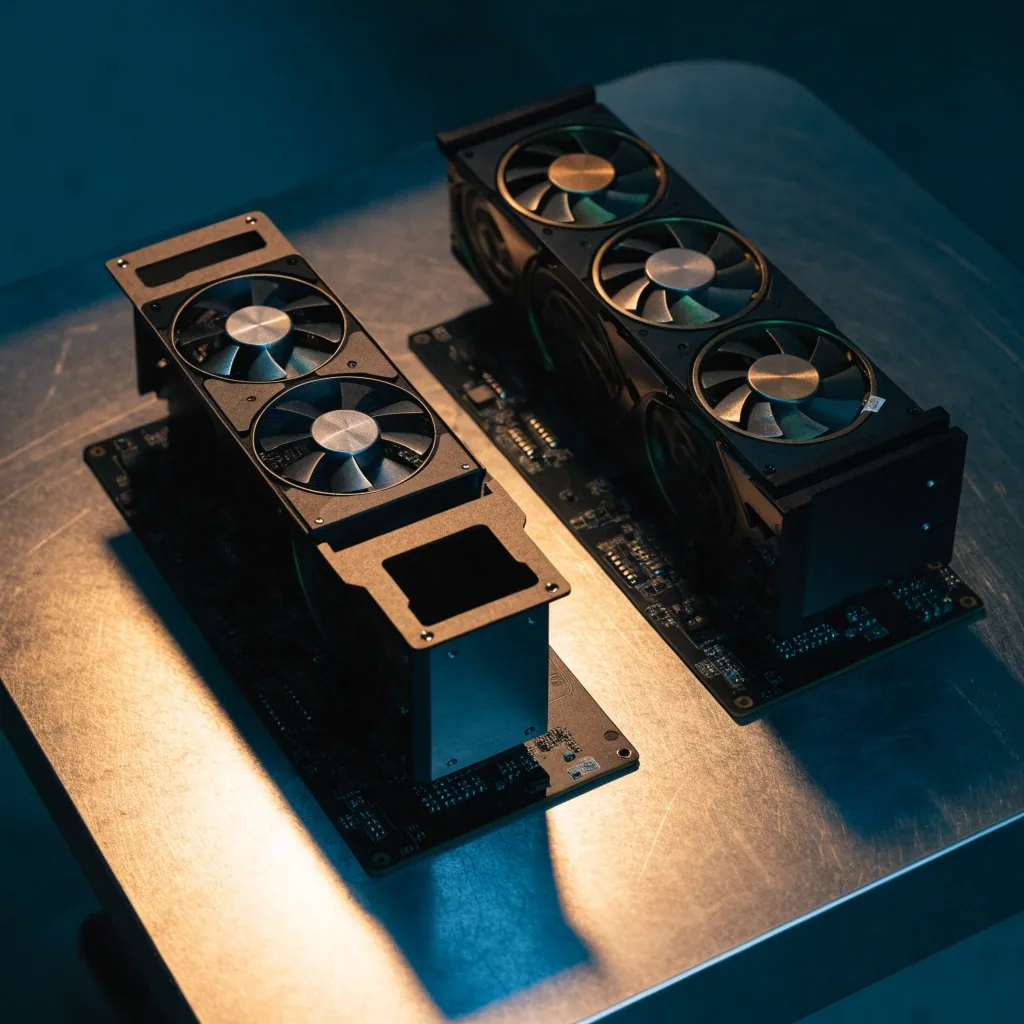
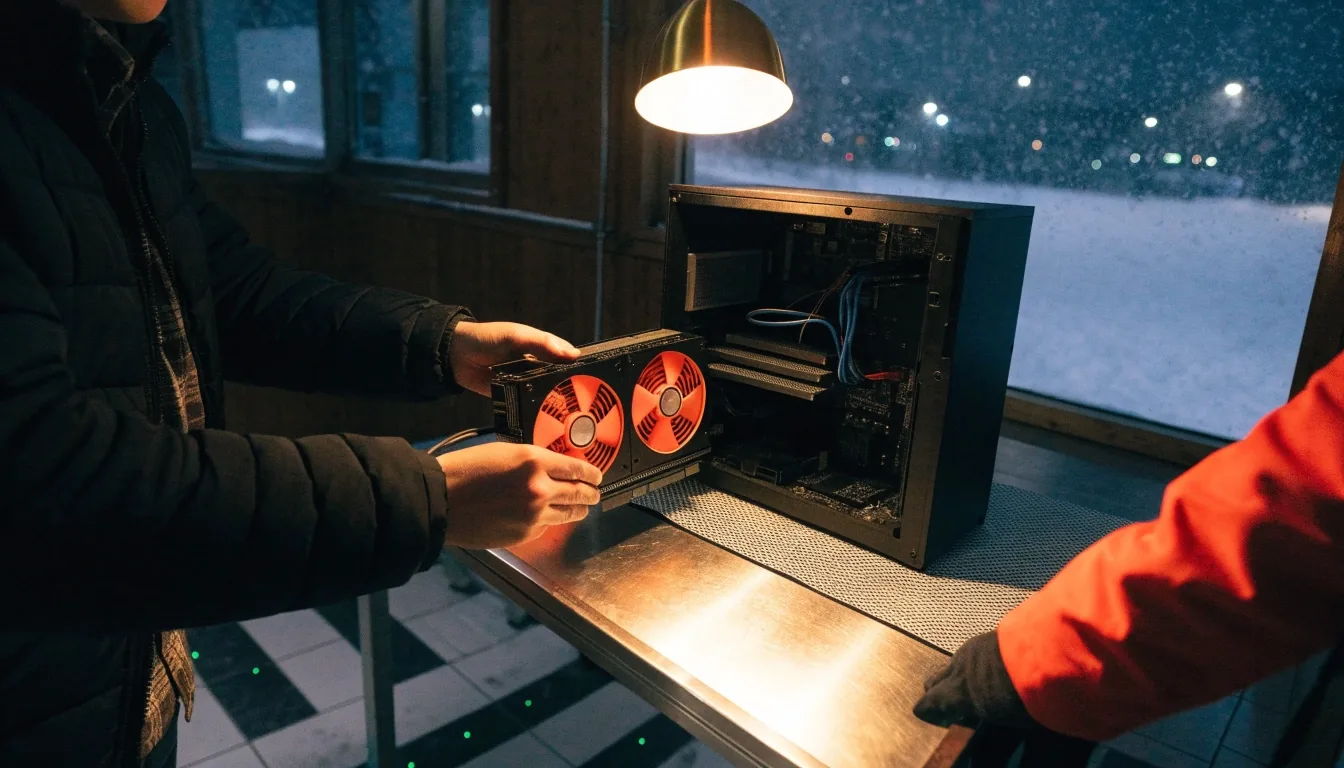
A lot of the cases selling in Korea are compact, and card length is a real constraint. We keep dual-fan cards like the MSI RTX 5060 Ti VENTUS 2X PLUS OC specifically for these builds, alongside the larger triple-fan models for people with full-size cases. Bring your case model and we will check clearance before you commit to anything.
Clearance is measured on the card's own length plus cable bend room at the connector, and on the slot width a thicker shroud eats. Two cards with the same chip can differ by more than a centimetre.
If your case is tight, say so on the phone and we can hold a short list of cards that actually fit before you make the trip into Jongno-gu.
A reading we mention before quoting
₩1,109,280
A cited RTX 5070 listing around 1.1 million won. We quote from live listings, not from this figure.
We do not set prices in isolation. Korean GPU listings move with stock, exchange rates, and distributor allocations, and Danawa is where that shows up first. RTX 5070 listings have been cited around 1.1 million won, and the RTX 5060 Ti 8GB and dual-fan MSI 5060 Ti both appeared in tracked increases in 2026. We check current listings before quoting, and we will tell you when a price looks temporarily high.
On Korean GPU pricing
Prices on this hardware do not sit still. When a model is short, the listing moves within days, and when a distributor allocation lands, it can fall back just as quickly. That is why we never quote a number from last month.
If your budget has a little room, waiting a few weeks is sometimes the better call, and we will say so rather than close a sale that does not help you.
Price Insight Korea
Creator, AI, and non-gaming buyers
Not everyone buying a card is building a gaming PC. Video editing, 3D rendering, and local AI workloads all change which card makes sense, mostly through VRAM and CUDA. NVIDIA has been extending the RTX platform toward creator and AI workflows, and RTX Spark appeared in its 2026 COMPUTEX announcements as part of that. If your work is not gaming, say so, and the recommendation changes.
Video editing
Encode and decode support matters, plus enough VRAM for timeline scrubbing on high-bitrate footage.
3D rendering
Render engines lean on cores and memory capacity; a gaming-first pick is often the wrong buy here.
Local AI work
VRAM capacity sets the ceiling on what runs locally; CUDA support shapes which tools work smoothly.
What we will not do
We will not push a card that does not fit your build, we will not pretend a factory OC clock speed matters more than the cooler, and we will not tell you to buy today if waiting is the better call for your situation. A card sold to the wrong buyer comes back, and that is worse for everyone.
The same rule covers the advice itself. If your monitor is the thing holding your frames back, we will say that first, even when the visit ends without a sale.
Visiting and contacting us
The store is at 12, Saeun-ro, Jongno-gu, Seoul, 03157. Phone is +82-2-2268-1234. Bring your case model, monitor resolution and refresh rate, power supply wattage, and a rough budget. That is enough for us to give you a shortlist of two or three cards on the spot, with the tradeoffs spelled out.
Opening hours are Monday to Friday, 09:00 to 18:00. For stock questions before a trip, a phone call is faster than a message.
Answer-ready shortlist
Bring those four details and we can name two or three cards with their tradeoffs in one visit.